


Seasons of Life in the Great Himalayan National Park
A little bouquet of flowers from the park can brighten an entire day. In the Great Himalayan National Park, seasons are not just dates on a calendar, they are visible in every slope, stream, forest, and village ritual.
Rhythms of the Seasons, Rhythms of the Park
From the ancient Greek story of Persephone and Demeter to the Biblical phrase “To everything there is a season”, humans have long used myth and faith to explain the cycles of nature. In GHNP, this idea is literally written on the land. On a single day’s trek, a visitor may start in sub-tropical warmth at lower altitudes and climb into cool temperate or sub-alpine spring higher up, where buds are only just opening. Vegetation, bird song, animal behaviour, and even the feel of the wind changes with altitude, aspect, and time of year.

Approaching Kandi Galu located on dividing Sainj and JiwaNal catchments
Western Himalaya Setting
GHNP lies in the Western Himalayas, where:
-
The snowline is lower than in the eastern Himalayas.
-
Winter snowfall is heavier, and glaciers often descend lower.
-
The climate is relatively more temperate, with pronounced seasonal changes in flora and fauna.
About 66% of the Park is in the alpine zone (3,200–4,000 m)
Snow can fall as low as 1,500 m
Rainfall occurs through the year, most abundant during the monsoon (July–September)

GHNP peaks above Sainj from Dhel Meadow

Well-preserved low-altitude broadleaf mixed forests
Spring
Mar - Apr
Summer
May - Jun
Monsoon
Jul - Sep
Autumn
Oct - Nov
Winter
Dec - Feb

Sorbaria tomentosa

Ribes sp-fruiting branch

Cotoneaster microphyllus-fruits

Daphne papyracea-flowers
%20tree%2C%20GHNP%20Ecozone.jpg)
An apricot tree, GHNPCA Ecozone

Flowering Spike Aesculus indica

Prunus cornuta

Potentilla sp.

Buttercup
%20Dhel%20Meadow%2C%20June%202011_JPG.jpg)
Marsh Marigold

Moist Temperate Deciduous Forest in Khorli Poi, Tirthan Valley

Fresh flush of leaves, Tirthan Valley
Higher up, alpine meadows reveal valuable medicinal herbs as snow recedes:
-
Picrorhiza kurroa, Aconitum species, Podophyllum hexandrum, Dactylorhiza hatagirea, Meconopsis aculeata, Saussurea simpsoniana, Jurinea macrocephala and others.
-
These have long histories in Indian and Chinese medicine and were heavily exploited before stronger protection. Traditionally, local people harvested only after Bees Bhandon (October), once seeds had matured—a practice that favours regeneration.

Lichens hang from Kharsu oaks and coat rocks, indicators of clean air and important for ecology and aesthetics.
Rhododendrons on the Climb
As the snowline retreats, Rhododendrons light up the slopes. These flowers attract many birds and are also used by local people.
Burans flowers, for example, are dried for chutneys and drinks believed to benefit cardiac health.
_JPG.jpg)
Rhododendron arboreum (Burans), bell-shaped flowers in lower forests

R. campanulatum (pale purple, state flower of Himachal Pradesh)

R. lepidotum (purplish-pink)

R. anthopogon (cream-coloured, the highest-growing species)

Picrorhiza kurroa

Picrorhiza kurroa

Aconitum violaceum

Dactylorhiza hatageria

Meconopsis aculeata

Jurinea macrocephala
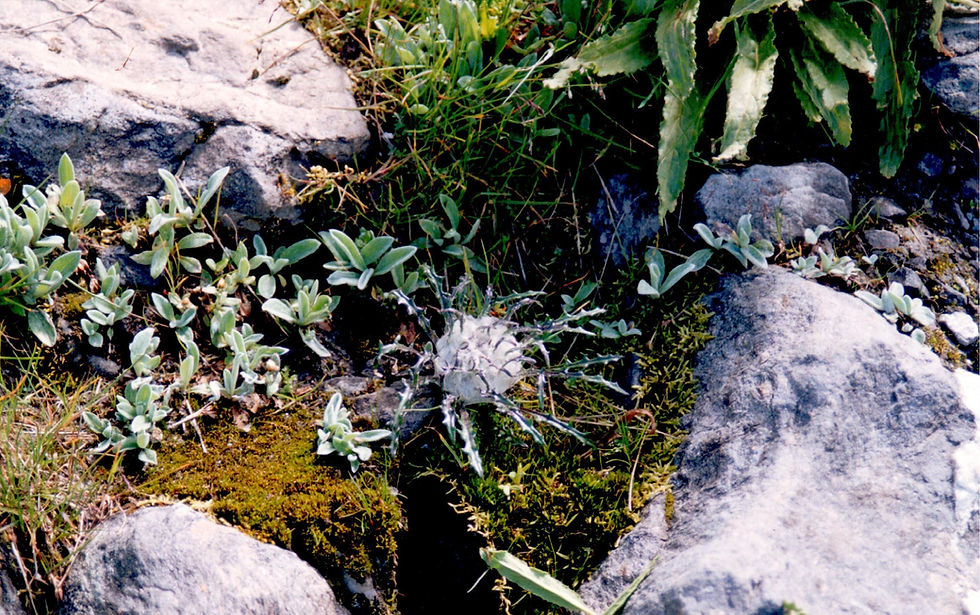
Saussurea simpsoniana
(Snowball Plant)
Spring: Renewal in Forests and Villages
Cultural Spring – Basant Ritu
With the arrival of Basant (spring), villages around GHNP celebrate renewal:
-
Food is coloured more deeply with turmeric, echoing the yellow of mustard fields and wild spring flowers like Buttercups, Potentilla, Marsh Marigold and dogwood bracts.
-
Basant Panchami marks the birthday of Saraswati, goddess of knowledge, art, and music. Local musicians play Pahari songs on the shehnai to invoke wisdom and a “new life” after winter.
-
In nearby Kullu, Holi celebrations begin early, with colour first applied to the idol of Lord Raghunath on Basant Panchami, almost a month before the nation-wide festival.
Deciduous Forests: Spring and Autumn on Display
The Moist Temperate Deciduous Forest is one of GHNP’s most striking seasonal forests:
-
In spring, broad-leaved trees burst into fresh green leaves and flowers, breaking winter dormancy as temperatures rise.
-
In autumn, these trees withdraw nutrients from their leaves, which change colour to yellow, red or brown before falling.
-
The fallen leaves form a thick forest floor litter, gradually releasing nutrients back to the soil and supporting a rich litter fauna.
Some evergreen broad-leaved trees, like Kharsu oak, keep their leaves through winter thanks to thicker, tougher foliage—an adaptation to snow.
Ecozone Blossoms: Apricots and Elms
In March, the ecozone (buffer villages and fields) comes alive:
-
Apricot (Prunus armeniaca / Khurmani) trees along field margins are covered in pink blossoms, often appearing before the leaves.
-
Villagers use the fruit both fresh and for oil, and Women’s Saving & Credit Groups have adopted apricot oil as an alternative income source.
-
-
Elms (Ulmus wallichiana) show purple-brown buds and vase-shaped crowns.
-
Alders (Alnus nitida) in riverine forests push out bright green leaf buds and catkins.
-
Other deciduous trees—walnut, horse chestnut, maple, Carpinus, Corylus, Prunus, Populus—add to the colourful spring canopy.
Shrubs, Cryptogams, and Spring Herbs
With snow melt, a wide range of shrubs and non-flowering plants emerge:
-
Shrubs such as Indigofera, Sorbaria, Ribes, Rhamnus, Berberis, Cotoneaster, Daphne, Desmodium, Lonicera, Viburnum—many now grown ornamentally around the world.
-
Mosses, fungi, and ferns flourish in moist spots; fern fiddleheads uncurl, and tiny liverwort capsules sparkle in morning dew.
A Living Calendar
From spring blossoms in village apricot orchards to monsoon mists over alpine meadows, from autumn’s nut-rich forests to winter tracks in the snow, the Great Himalayan National Park is a living calendar of the Himalayas.
Altitude, aspect, snow, rain, plants, animals, and human traditions all work together to create a landscape where, truly, “to everything, there is a season.” Every visit—whatever the month—reveals a different, but equally compelling, face of this Western Himalayan wilderness.

Morning mist at Khandedhar meadow, JiwaNal Valley
Multi-Year Phenomena

Mass pollen release (greenish-yellow dust) in conifers, usually every two years, strongly influenced by temperature and humidity.

Cicada emergences in lower forests, when millions of insects appear, sing loudly, and leave behind nutrient-rich shells; intervals are several years long.

Flowering and die-back of Ringal bamboo (Sinarundinaria falcata), historically around every 32 years; flowering in 1999–2004 left areas temporarily bare and vulnerable to erosion until regeneration.
The Remarkable Oaks and Climate Signals
Key features:
-
Vivipary in Kharsu and Moru oaks (seeds germinate while still attached), helping seedlings access monsoon moisture.
-
Changing intervals between “good seed years” (from 2–3 years to 3–4 years) suggest climate change impacts.
-
Oaks are “evergreen” by overlapping leaf generations; leaves live about one year but leaf fall is staggered.
Kharsu oak stands above Nada Thach are excellent examples of climax forest in these conditions.

Ban Oak (Quercus leucotrichophora)
1,800–2,400 m

Moru Oak (Quercus dilatata-acorns)
overlapping middle belt

Kharsu Oak (Quercus semecarpifolia-acorns)
2,000–3,500 m, especially on south-facing slopes